Beyond the polarity flip: what phase rotation actually does
When two microphones capture the same source, one of the first buttons most of us reach for is the polarity switch.
Sometimes the difference is huge. One position sounds thin or hollow; flip the switch and the sound gets fuller and more solid. It is quick, useful, and built into almost every mixer and DAW. But it only gives you two choices.
A polarity switch lets you hear the relationship at 0° or 180°. A broadband phase rotator gives you the whole circle.
That sounds simple, but there is a terminology trap here: polarity inversion, phase rotation and time alignment are often talked about as if they were the same thing. They are related, but they are not interchangeable. This article looks at what each one actually does, why a 180° broadband phase rotation is equivalent to a polarity inversion, and why the rest of the circle can be useful when combining multiple microphones.
- Polarity switch — 0° or 180°, and nothing else.
- Phase rotation — any angle around the circle. Phrotator sets it in 0.1° steps.
Watch: polarity flip vs phase rotation
The video goes through the same ground as this article, and plays all five of the phase sweeps further down the page.
What a polarity switch actually does
A polarity inversion is about as simple as audio processing gets. Every sample is multiplied by
−1. Positive values become negative, negative values become positive. The waveform
is turned upside down, but it is not moved forward or backward in time.
y(t) = −x(t)
This is why “polarity invert” is the more precise name for the button that is still sometimes labeled with a phase symbol, or casually called a “phase flip”.
And here is an important point for the rest of this article:
A broadband 180° phase rotation produces the same result as polarity inversion.
At 180°, the entire waveform is multiplied by −1. So a polarity switch can be
thought of as giving you one particular phase-rotation choice: 180°. Its limitation is simply
that it cannot stop at 30°, 75°, 120°, 240° or anywhere else.
The second half of the circle is not a repeat of the first, either. Adding 180° to any angle also flips the polarity, so 270° is 90° inverted, not 90° again. Every point on the circle is a relationship of its own.
Why “180 degrees out of phase” gets confusing
A lot of the confusion comes from sine waves. Take a single sine wave, delay it by exactly half of its period, and the result looks identical to an inverted version of the original.
For a 1 kHz sine wave:
- one full cycle lasts 1 ms
- half a cycle lasts 0.5 ms
- a 0.5 ms delay therefore corresponds to 180° at 1 kHz
So for that one frequency, a half-cycle time shift and a 180° inversion can look exactly the same. That makes it tempting to conclude that phase shift is simply another way of describing time shift. For real music and recorded audio, that conclusion does not hold.
A time delay creates phase shift — but the amount depends on frequency
A fixed time delay produces a different phase angle at every frequency. Ignoring sign convention, the relationship is:
phase shift = 360° × frequency × delay
Take the same 0.5 ms delay:
| Frequency | Phase shift from 0.5 ms |
|---|---|
| 200 Hz | 36° |
| 1 kHz | 180° |
| 2 kHz | 360° |
| 5 kHz | 900° |
The delay is still 0.5 ms at every frequency. The phase angle is not.
This is exactly why two microphones at different distances from a source develop a complicated phase relationship. The arrival-time difference is one fixed amount of time, but its phase consequence varies with frequency. So this is worth keeping in mind:
A time shift creates a phase shift, but a phase shift does not necessarily mean shifting the whole signal in time.
Phase can also be rotated without a time offset
Broadband phase rotation is a different operation. Instead of moving the entire signal earlier or later by a fixed number of milliseconds, a broadband phase rotator changes the phase angle of the signal while preserving its magnitude response.
That distinction is easiest to see on a graph of phase against frequency:
- a fixed time delay produces a phase shift that changes with frequency
- a broadband phase rotation applies the chosen angle across the band
- 0.5 ms time delay — the angle grows with frequency
- 90° broadband phase rotation — the same angle everywhere
- Polarity inversion — 180° everywhere
At 180°, broadband phase rotation lands on the same result as polarity inversion. At other angles, it gives you relationships a polarity switch cannot produce.
A 90° rotation, for example, is not “a certain number of milliseconds” for a complex broadband signal. The time equivalent of 90° would be different for every frequency. That is the key difference.
Why this matters with multiple microphones
Now take two microphones recording the same source. They may be at different distances. They may use different capsules. Their electronics may have different phase responses. Reflections and spill may also arrive differently at each mic.
By the time those signals reach the mix, their relationship is already frequency-dependent. Flipping the polarity of one mic adds 180° to that relationship. Sometimes that happens to produce a much better sum, which is why the polarity button is such a useful first check.
But there is no rule saying the most useful relationship must occur at exactly 0° or 180°. A broadband phase rotator lets you move away from that binary choice.
As you rotate one signal relative to the other, the way the two signals reinforce and cancel changes. Depending on the recording, you may hear changes in low-end weight, attack, body, focus, or the overall sense that the microphones are working together.
There is no universally “correct” angle. The useful setting is the one that makes the combined signal work for the recording and the mix.
Hear the difference
Each example below is two microphones on the same source, summed. Phrotator sits on one of them and turns once around the circle, from 0° to 360°, over the length of the clip. Nothing else changes: the mic levels and all other processing stay where they are.
So the start and the end of each clip are the pair as recorded, and the middle, at 180°, is where the polarity switch would put it. Everything else is what the switch cannot reach. Listen to the sum: the point is how the two signals interact, not how the rotated one sounds on its own.
Distorted guitar 1
Two microphones on the same guitar cabinet.
Snare, top and bottom
One microphone above the drum and one below it. They face opposite sides of the drum, which is why the polarity switch is the usual first move here.
Bass, DI and amp
The DI and a microphone on the bass amplifier: the same performance through two very different paths.
Distorted guitar 2
Two microphones on the same guitar cabinet.
Distorted guitar 3
Two microphones on the same guitar cabinet.
The waveforms are drawn from the audio itself, with the angle along the bottom. Where the sum gets quieter as the angle changes, the two microphones are cancelling more of each other.
Phase rotation is not time alignment
This distinction matters. If one microphone arrives 0.8 ms later than another and your goal is specifically to remove that arrival-time difference, use a delay, a sample offset, a track nudge or a dedicated time-alignment tool.
Phrotator does not move the track by a corresponding amount of time. It gives you another way to alter the phase relationship after the signals have been recorded. In practice, time alignment and phase rotation can be complementary:
- Correct an obvious timing offset, if you actually want the arrivals aligned.
- Check the polarity relationship.
- Use phase rotation if you want finer control over how the signals combine.
You do not always need all three steps. Sometimes the original timing sounds best. Sometimes a polarity flip is enough. Sometimes an intermediate phase rotation gives you the result you were looking for. Use the tool that matches the problem.
A practical Phrotator workflow
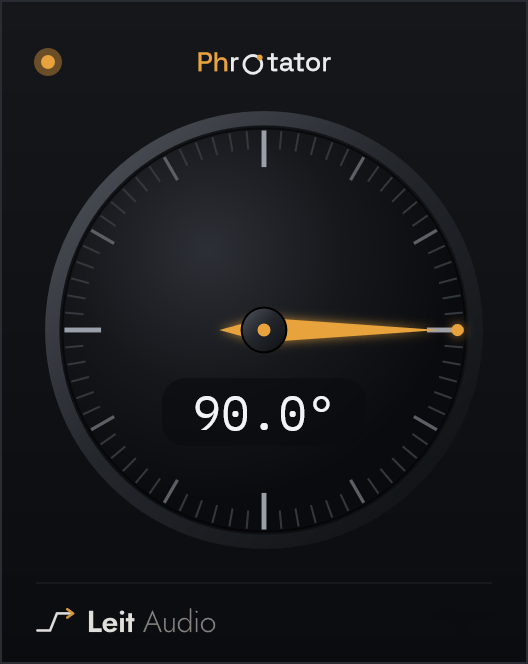
Phrotator is a broadband phase rotator with continuous 0–360° control and 0.1° resolution. For a multi-mic recording:
- Set the relative mic levels where you want them.
- If there is an obvious arrival-time problem that you want to correct, deal with that first.
- Listen at 0°.
- Check 180°.
- Insert Phrotator on one of the signals and sweep slowly through the range while both are playing.
- Listen for the relationship that works best in context.
- Bypass and re-check the original before committing.
Do not chase a number on the dial. The angle is not a quality score. The useful setting is the one that gives you the combination you want.
FAQ
Is polarity inversion the same as a 180° phase rotation?
For the broadband operation discussed here, yes. Both produce −x(t): the
waveform is inverted.
The terminology becomes confusing when people use “180° phase shift” to describe a time delay. A delay can equal 180° at one particular frequency while producing different phase shifts at other frequencies.
Does phase always mean time?
No. A time offset creates a frequency-dependent phase shift, but phase can also be changed without applying one simple time offset to the whole signal.
Does Phrotator fix microphone timing?
No. It is a phase rotator, not a time-alignment tool. If the problem you want to solve is the actual arrival-time difference between microphones, use a timing adjustment.
If Phrotator has processing latency, isn’t that a time delay?
Processing latency and the phase rotation are separate things. Phrotator uses block-based processing and reports its latency to the host. With normal plugin delay compensation, the DAW compensates for it, so the processed channel stays in sync with the rest of the session. The latency is not how the phase rotation is created.
Does phase rotation change the frequency response of the processed channel?
Phrotator is designed to preserve the signal’s magnitude response while rotating its phase. The processed signal can still combine very differently with another, correlated signal, because the sum depends on their relative phase.
The simple takeaway
A polarity switch is useful because 180° can make a dramatic difference. But 180° is only one possible relationship.
Polarity inversion gives you two points on the circle: 0° and 180°. Broadband phase rotation gives you all of it.
That can be especially useful with multi-mic recordings, parallel processing, and other situations where two related signals need to work together. Phrotator was built for exactly that job.